Georgia Strait Alliance is the only citizens' group focused on protecting the marine environment in and around the whole Strait of Georgia – Canada's most at-risk natural environment, and the place where 70% of British Columbians live, work and play. We are committed to a future for our region that includes clean water and air, healthy wild salmon runs, rich marine life and natural areas, and sustainable communities.

Showing posts with label Kinder Morgan. Show all posts

November 24, 2014

Local election results: a win for the coast, climate and communities

Election night 2014 was a great moment for all those in BC who want to stop pipeline and tanker projects that threaten our coast and our climate.

From big city mayors to small town councillors, communities up and down the coast elected local leaders who promised to work in office to stop the Enbridge and Kinder Morgan pipelines. Vancouver, Burnaby, Victoria, Esquimalt, Prince Rupert and Smithers all elected mayors who are opposed to tar sands pipelines.

In the Vancouver Island community of Sooke, 70% of residents voted YES to a referendum question that commits the district to opposing the Kinder Morgan pipeline.

Across the province, fossil fuel projects and community control over environmental decision-making proved to be a defining issue in many local races. Although traditionally considered federal and provincial matters, this year’s municipal election campaign saw many candidates speaking out about the risks oil, coal and LNG transport could bring to their area, and demanding a greater say in the decision-making process. It was a telling sign of how concerned communities are about this issue, and how ignored they feel by other levels of government.

At Georgia Strait Alliance, we contributed to the debate by working in selected strategic locations around the Strait: Nanaimo, Parksville, Gibsons and the Sunshine Coast. We sent questionnaires to all registered candidates in these locations – 125 in total – asking their views on the Kinder Morgan pipeline as well as oil spill risk and response capacity. We circulated candidates’ replies to our supporters via email and published them on our website and social media, encouraging people to get informed, ask questions at all-candidates’ meetings and above all, get out and vote. 

You can find the full survey results here. The vast majority of candidates who responded to our survey were opposed to the Kinder Morgan expansion project, did not feel their communities had adequate resources to prepare for an oil spill, and were concerned about the recent decision by the National Energy Board to overrule the City of Burnaby’s bylaws to allow Kinder Morgan to conduct surveying work on Burnaby Mountain. Most also said that if they were elected, they would work to ensure that residents’ views on Kinder Morgan are heard by the federal authorities who will ultimately decide the project’s outcome. 

We were thrilled that when the votes were counted, many of these candidates were chosen to lead in their communities – particularly on the Sunshine Coast, where 65% of those who completed our survey were elected – and we look forward to working with municipalities around the Salish Sea in the coming months to ensure that community needs and voices are not ignored in this historic debate.

As the dramatic events unfolding on Burnaby Mountain over the past few days have brought into sharp focus, we need local leaders who are willing to stand up for their communities now more than ever. How many municipalities need to say ‘no’; how many First Nations need to launch lawsuits; how many ordinary citizens need to get arrested before the federal government and Kinder Morgan get the message that this pipeline will never be built? Whatever the NEB and Cabinet decide, it is abundantly clear that Kinder Morgan will never gain social license in BC – and that the future we want will have to be created by the local communities showing such great leadership today.

October 30, 2014

It’s local election time!

On November 15th, British Columbians will go to the polls to vote for local leaders to represent their communities.

While local elections may not generate as much attention on the airwaves or around the water cooler as provincial and federal races, they are vitally important – and not only at the local level.  Newly elected mayors, councillors and regional representatives will not only make countless decisions that will affect daily life in our communities – they can also play a major role in a much wider political arena.

For many of us concerned about the local and global impacts of pipeline projects and other fossil fuel development in BC, it increasingly feels like the provincial and federal governments are simply not listening. But communities like Burnaby (which is using all the mechanisms at the city’s disposal to prevent the Kinder Morgan pipeline expansion, including a drawn-out legal battle to prevent the company from carrying out invasive surveying work on Burnaby Mountain conservation lands), or Kitimat (where last April, citizens rejected the Northern Gateway project in a plebiscite) are showing us how local governments can flex some serious political muscles and be influential players in this vital national conversation.

We need more local champions like these, and the upcoming municipal elections are an important opportunity to spark community debates about the risks and benefits of Kinder Morgan and other energy projects, and for citizens to choose representatives who will stand up for the rights of communities over fossil fuel companies.

Georgia Strait Alliance is working in strategic locations around the Strait to encourage such debates during the election period, and in particular to raise awareness among candidates and voters of the risks coastal municipalities would face in the event of an oil spill. 

If you live on the Sunshine Coast or the Nanaimo and Parksville areas,click here to find out where your candidates stand on these issues, and other useful information as you prepare to vote on November 15th.

Wherever you live, if you’d like to see your local government be a champion for the coast and the climate, here are three things you can do to make the most of the upcoming local elections
  1. If you have five minutes: ready, set vote! Visit your municipality’s website and make sure you know when and how to vote.  Talk to your friends and family and make sure they’re ready to vote as well.
  2.  If you have half an hour: write an email. Contact your candidates (see here for an email directory of candidates running across the province) and ask them their views on issues of concern to you (you can use our candidate survey as a guide). You could also consider writing a letter to the editor of your local paper – a great way to contribute to the debate in the wider community.
  3.  If you have an evening to spare: attend an all-candidates’ meeting in your area to find out more about your candidates, and ask them questions about what matters to you (feel free to use ours). Your local newspaper or municipality’s website is the best place to find out dates for the meetings.
If you would like help with any of the above – who to contact, what to write, no question is too big or too small – we’re here to help! Contact alexandra@georgiastrait.org or call 604-633-0530.
Whether it’s pipeline and tanker projects that worry you, or other local environmental or community issues, November 15th is too important an opportunity to miss – so mark your calendars, and get out and vote! 

July 21, 2014

Kinder Morgan hearings delay: a win for pipeline opponents

This week the National Energy Board (NEB) announced that it was ‘stopping the clock’ on its review of Kinder Morgan’s proposed pipeline expansion, which will delay the NEB’s final recommendation – and the ultimate federal Cabinet decision – until 2016.

Tanker under Second Narrows Bridge
Photo: Sarama (www.livingsalishsea.ca)
The delay is due to the fact that Kinder Morgan changed a portion of its ‘preferred route’ for the new pipeline after it filed its application to the NEB last December. The NEB is providing the extra time so that Kinder Morgan can carry out additional studies on the new route, which involves tunneling through Burnaby Mountain. When the route change came to light in May, many community members called for the NEB review to be paused or restarted, particularly those in Burnaby who could be most directly affected by the route switch.

There’s no doubt that major flaws remain in the NEB review process: there still won’t be any in-person cross-examination of the evidence presented, Kinder Morgan is still failing to adequately answer the questions intervenors have been asking, and the project’s climate impacts are still barred from discussion.

However, the delay is most definitely a win for all of us who have been criticizing both the project and the process.

The longer the review takes, the more likely it is that one of the many obstacles to the project’s completion will be successful, including changing market forces, a raft of lawsuits from First Nations and others, and citizens from across BC mobilizing to oppose the project. Perhaps most notably, the final decision to approve or deny the project will be made by whoever wins the next federal election in 2015, giving citizens a chance to hear where all the parties stand on Kinder Morgan, and the opportunity to vote accordingly.  

If you’re an intervenor or a commenter in the NEB review, here are the key new deadlines you should be aware of:

·         Deadline for commenters to file letter of comment: March 16, 2015 (commenter workshops will now take place in February 2015)
·         Deadline for intervenors to file written evidence: March 16, 2015
·         Deadline for intervenors to file written argument: July 29, 2015
·         Oral hearings: July 2015
·         NEB releases its final report and recommendations: 25 January, 2016

You can find out more from the NEB’s table of revised hearing events, and as always, if you have any questions or comments, please get in touch at alexandra@georgiastrait.org.win

July 4, 2014

Ryan joins GSA for the summer

Hello GSA supporters,

Ryan with his friend and classmate Rabbi Salih
during his recent convocation ceremony. 
My name is Ryan Butler, and I am excited to be joining GSA’s dynamic staff this summer as the Clean Marine Outreach and Engagement Coordinator. Prior to this position, I’ve worked and volunteered with several NGOs and student organizations, such as: Camp Hornby, The World University Service of Canada, and The Radio Malaspina Society.

Having recently graduated from Vancouver Island University with a degree in sociology and political studies, I am thrilled to have found a summer job that is relevant to my field. Come September, I intend to carry my summer experience forward into my Master’s program at the University of Victoria.

I believe that all Canadians ought to undertake practices that protect or restore our environment whenever possible. As such, I am excited about joining GSA where I can fulfil this belief while still working. Here, students are able to making significant contributions to our public discussions regarding both regional and global issues.

Identifying environmental hazards is, of course, necessary but insufficient for creating change. Instead, change requires social and political processes to create and implement a variety of solutions. GSA’s Clean Marine BC program is one such solution, and therefore, I’m excited to contribute to its expansion this summer. Having previously researched the establishment of B.C.’s Forestry Stewardship Council, I appreciate how such eco-certification programs provide businesses and consumers with an avenue for reducing their environmental impact.

I am excited about the Clean Marine BC program, but I also recognize that GSA’s current Spills and Tankers Campaign, against the expansion of Kinder Morgan’s Trans-Mountain pipeline and increased fossil fuel exports, is confronting the region’s greatest environmental threat. Many of the benefits of CMBC would be greatly diminished should the Strait experience a major tanker spill, but together these GSA programs show that achieving environmental sustainability will require both preventative and adaptive actions.

I am proud to be contributing to GSA’s encompassing environmental work to protect the Strait, its adjoining waters, and its communities. 

June 25, 2014

Summer Outreach Begins!


Hello Fabulous Readers!

Taking a break from field work with the Larabanga
Girls Dance Group in Larabanga, Ghana
My name is Natalie and I am one of the lucky students who was hired to work with the Georgia Strait Alliance throughout the summer.

I’m a life-time resident of Nanaimo, and I just finished the third year of my degree in Tourism Management at Vancouver Island University. In my free time I love trail running, gardening, and exploring as much as possible with Skeena, my one year old Shiba Inu.

I wanted to work with GSA because I love the Georgia Strait!  I also believe in the power of community conservation management. Last summer, I traveled to Ghana and visited the Wechiau Community Hippo Sanctuary, which is made up of several communities that work hard to protect the resident hippo population. The conservation model was very complex, but through tourism, the community was able to benefit in many ways. Some residents had to change their behaviors, but they were still able to go about their daily lives. Even though the Georgia Strait covers a much greater area and population base, I believe that the Strait Community can come together and experience many positive benefits if everyone participates in making it happen.

The thing I’m looking forward to the most this summer is traveling around and talking with the public. I love meeting people, chatting, and making sure that everyone is enjoying themselves.  The Georgia Strait Alliance has some very powerful campaigns on the go, and people are very interested. This past weekend, Ryan and I had some great conversations surrounding the Drift Card Study and the Kinder Morgan Expansion. People were in awe with the spill maps and seeing how far and fast oil from a spill could spread. Community outreach is a great way to spread awareness with people, and also hear what individuals have to say.  Make sure if you see us out on the road somewhere that you stop by to say ‘hello’!

The program I’m most excited to help out with is GSA’s newest program- The Waterfront Initiative! I’m so thrilled with this idea because it brings everyone together in a brand new way and for a powerful purpose. Regardless of how individuals use the waterfront in Vancouver – work, home, industry, or play – the Waterfront Initiative has the power to create a collective image of what the waterfront should look like and work to make that happen. After all, isn’t the waterfront one of Vancouver’s most beautiful assets? I hope to help out with the launch of this project as much as I can while I’m here, throughout the summer and beyond.

June 20, 2014

New chapter, new resolve against unwanted pipelines

The approval of the Enbridge Northern Gateway pipeline makes it clearer than ever that BC is going to have to have to stand up for itself in the face of a federal government willing to impose unwanted projects despite overwhelming opposition – and the response of First Nations and British Columbians to the news this week has shown an unwavering resolve and an inspirational source of hope that we can win this fight.

Although Northern Gateway has now cleared another major regulatory hurdle, a combination of First Nations legal challenges, a citizen push-back that could range from a province-wide vote to civil disobedience, and (at least currently) a strong ‘no’ from the Provincial government mean that the pipeline is unlikely to ever be built.

When Enbridge first floated the proposal in 2005, no one could have imagined how controversial it would become: at the time such projects were usually nodded through without a great deal of interest. Now it’s shaping up to be a defining issue for many BC communities and  a top voting issue in the 2015 federal election.

The campaign to stop Northern Gateway has also built a broad and strong coalition, and sparked a powerful citizen’s movement. We are grateful to everyone who has worked so tirelessly for so long, especially First Nations and non-indigenous communities on the front-lines in northern BC, and we want you to know that we stand with you, and are inspired by your leadership and resolve.

We are also grateful for the path that has been forged –  the lessons learned and the alliances built –  that those of us working on the south coast are now following in our efforts to stop Kinder Morgan’s pipeline proposal. This project too was once seen as a “slam-dunk”, and now struggles against “overwhelming opposition” (to quote the Financial Post, no less). Polls are showing rising levels of concern, at least two legal challenges are already underway, and the NEB’s review process has more people involved as intervenors and commenters than any project in its history. In other words, the Kinder Morgan pipeline is shaping up to be a battle royale too.

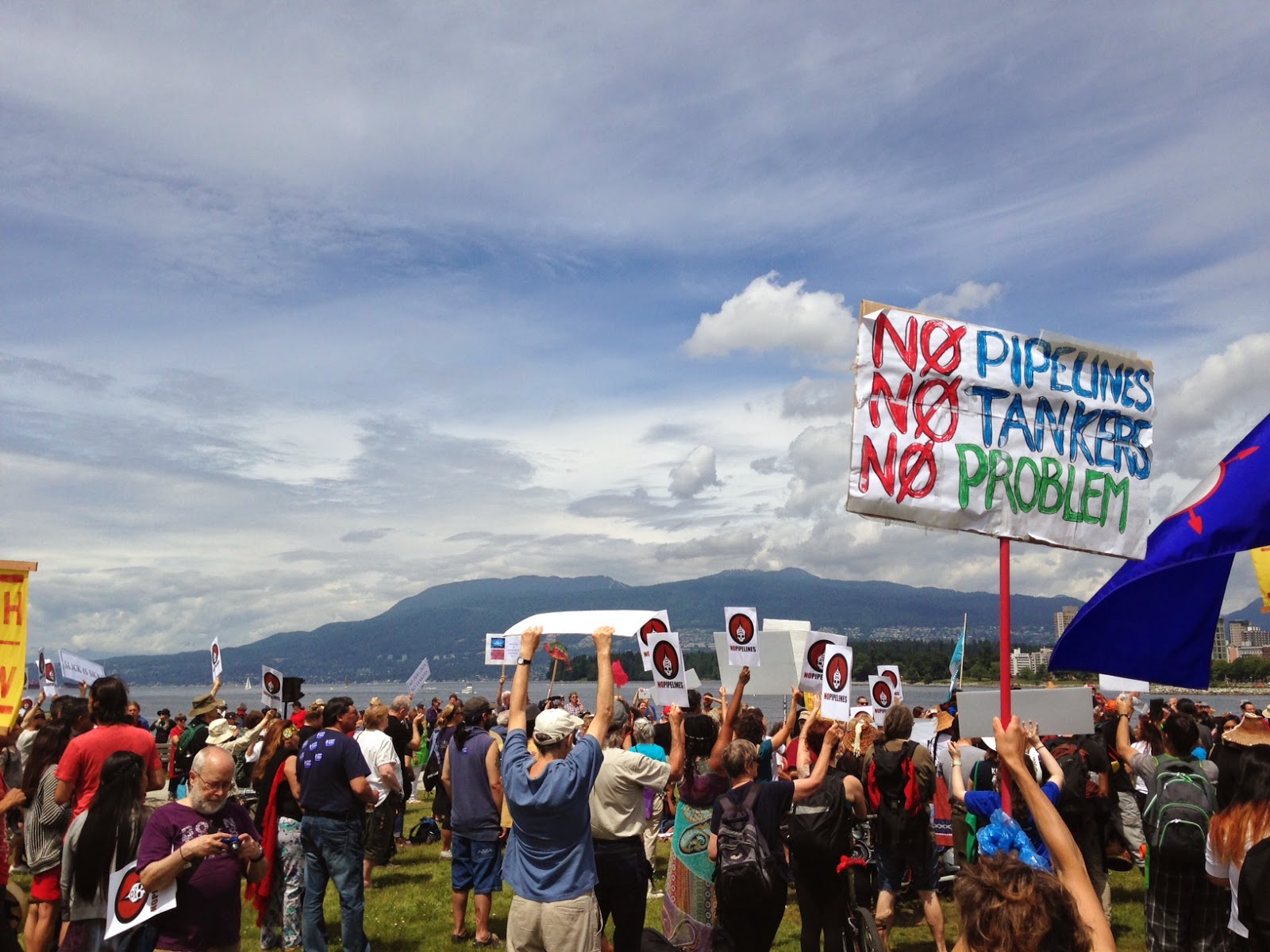
Protect Our Sacred Waters rally, Vancouver, June 2014
Photo: Alexandra Woodsworth
And for good reason. Kinder Morgan’s expansion poses the same threats as Enbridge – an oil spill that could devastate our environment, economy and coastal communities, and a yearly climate impact greater than the combined annual emissions of 90 nations – and the same negligible benefits for BC. Opponents of these projects aren’t NIMBYs. British Columbians don’t want risky tar sands pipelines or tankers anywhere in our province – we want to go in a different direction.  Our investments should help us transition away from fossil fuels, not tie us to more resource extraction and increase our contribution to climate change.

In the days leading up to the Enbridge decision, Premier Clark came under immense pressure to say ‘no’ to Enbridge, and it worked: the province said Enbridge had not met their five conditions, and they would deny permits if necessary. Those same five conditions apply to Kinder Morgan, and we need to bring the same pressure to bear to ensure the province takes a strong stand on the southern tar sands pipeline.

Compared to the JRP’s Enbridge hearings, the NEB’s Kinder Morgan review has dramatically restricted public participation and speeded up the timeline. And this week we learned just how brazenly the federal cabinet ignored public concern expressed during the JRP. Together, this means we need to work even harder to generate public pressure outside the formal review process.

We need to talk to more people in our communities, make more noise on the streets, raise more money for First Nations legal challenges, and – whatever it means for each of us – step up to the next level of what we’re willing to do to protect our coast and fight for a better future. Here’s a list as some food for thought, and stay tuned for updates on our Save the Salish Sea page.

January 16, 2014

The clock is ticking - apply to take part in the Kinder Morgan hearings today

This past Wednesday, the National Energy Board (NEB) quietly announced that it is taking applications for public participation in its review of Kinder Morgan’s proposal to expand the Trans Mountain Pipeline.

The window for individuals, business and groups to apply is quite short, with applications being accepted between January 15 and noon (PST) February 12.  If you don’t apply during this window, you won’t be able to officially comment on the project when the hearings roll around a few months later.

The bottom line? If you want to tell the government what you think about Kinder Morgan’s pipeline plan, you need to fill in this form.  This may feel daunting but we and our colleagues are here to help you have a voice in this process.  Here’s how:

Step 1. Visit the NEB website 
Read more about the process, to learn about webinars the NEB is providing and to fill out the online application form.  

Step 2. Learn more about what’s involved in participating in a NEB hearing process
When you fill out the application form, you can ask to be a ‘Commenter’ (submit a letter of comment) or ‘Intervenor’ (requires greater time commitment, allows you to take part in oral hearings, and allows you to ask for information of Kinder Morgan – and them of you). This website provides step-by-step advice alongside each page of the NEB online form.

Step 3. Get advice
We know the process looks daunting, and we want to make sure that everyone who cares about this issue gets the support they need to have their say. We and other organizations will be working together to hold workshops and webinars, and post information on our websites, to offer advice and help you fill out the form. Here are a few confirmed workshops and community meetings you can attend to get help:

Feb 3 - 7pm, Maple Ridge (hosted by Pipe Up Network and ForestEthics Advocacy)
Feb 4 - 7pm, Chilliwack (hosted by Pipe Up Network and ForestEthics Advocacy)
Feb 5 - 7pm, Abbotsford (hosted by Pipe Up Network and ForestEthics Advocacy) 
Feb 5 - 7pm, North Vancouver (hosted by ForestEthics Advocacy)
Feb 5 -12pm,  webinar (hosted by West Coast Environmental Law, Forest Ethics and Sierra Club BC) 
Feb 6 - 2pm - 8pm, Langley (hosted by Pipe Up Network and ForestEthics Advocacy) 
Feb 8 - 7pm, (note date change) Pender Island (hosted by Raincost, Gulf Island Alliance and GSA)
Feb 10 - 7pm, Downtown Vancouver (hosted by ForestEthics Advocacy)
Feb 11 - 6pm, Victoria (hosted by the Wilderness Committee)

The NEB process seems designed to ensure as few as possible people take part – restricting public participation, creating a primarily online process (getting hard copy forms is possible but must be requested through the NEB and takes time) and not taking climate change into account being high on the list– but it is your one opportunity to formally state your opinion, so make sure you don’t miss out.

Important:

·        To be able to participate, the NEB wants you to show that you are either ‘directly affected’ (eg. live or own property along the pipeline or tanker route, or have a job that could be affected by a spill etc.) or have ‘relevant information or expertise’ (ie. knowledge of a local place, or information about a relevant business sector such as tourism or recreation).  If you feel that you will be impacted in any way by Kinder Morgan’s project, it’s worth submitting an application and going on record that you want your voice to be heard.  Here is a guide to help.

·        Don’t let the first page dissuade you – setting up your account to apply is straight forward.   The NEB has added a first level of access that seems designed to frustrate possible participants – don’t give up!  Select “GCKey Login” and apply for your access key.  It won’t take long and soon you’ll be through to the actual form.  

Find out more:
    •        Using your voice: participating in the NEB’s review of Kinder Morgan’s pipeline and tanker proposal (2-page briefing prepared by Raincoast, Sierra Club and Pipe Up Network)
    •         Let BC Decide (website from Burnaby MP Kennedy Stewart)
    •         NEB PowerPoint presentation
    And don’t forget to spread the word!

    Share your concerns about Kinder Morgan’s proposal with your friends, family, neighbours and colleagues, and encourage them to get involved – whether it’s by registering to take part in the NEB hearings, contacting your MP or MLA, or getting active with one of the many community groups springing up to oppose this project.

    Please visit our website, and follow us on Twitter or Facebook to find out the latest.

    January 9, 2014

    Coming soon: your chance to take part in the Kinder Morgan hearings

    Next week, the National Energy Board (NEB) will start taking applications for public participation in its review of Kinder Morgan’s proposal to expand the Trans Mountain Pipeline.

    When the NEB publishes the application form (we expect on January 15th), you’ll have a short window of time (likely 30 days) to get you application in to the NEB. If you don’t apply during that window, you won’t be able to officially comment on the project when the hearings roll around a few months later.

    The bottom line? If you want to tell the government what you think about Kinder Morgan’s pipeline plan, you need to fill in that form – and start preparing now.

    Photo by James Fehon
    Step 1. Sign up for updates from the NEB so you find out right away when the call for participation opens.

    Step 2. Learn more about what’s involved in participating in a NEB hearing process. The NEB has yet to release full details, but here’s what we’re expecting. When you fill out the application form, you can ask to be a ‘Commenter’ (submit a letter of comment) or ‘Intervenor’ (requires greater time commitment, allows you to take part in oral hearings, and allows you to ask for information of Kinder Morgan – and them of you). To be able to participate, the NEB wants you to show that you are either ‘directly affected’ (eg. live or own property along the pipeline or tanker route, or have a job that could be affected by a spill etc.) or have ‘relevant information or expertise’ (ie. knowledge of a local place, or information about a relevant business sector such as tourism or recreation).  Whatever the form ends up saying, if you feel that you will be impacted in any way by Kinder Morgan’s project, it’s worth submitting an application and going on record that you want your voice to be heard.

    Find out more:
    •        Using your voice: participating in the NEB’s review of Kinder Morgan’s pipeline and tanker proposal (2-page briefing prepared by Raincoast, Sierra Club and Pipe Up Network)
    •          Let BC Decide (website from Burnaby MP Kennedy Stewart)
    •          NEB PowerPoint presentation
    Step 3. Get advice. We know the process looks daunting, and we want to make sure that everyone who cares about this issue gets the support they need to have their say. Once the NEB opens the call for applications, we and other organizations will be working together to hold workshops to offer advice and help you fill out the form. We’ll also distribute a guide to filling out the form, and will be available by email and phone to offer advice. Stay tuned to our website for more details.  In the meantime, MP Kennedy Stewart is holding a workshop in Burnaby on January 25th, and his office is another good port of call for information and advice.

    There are all kinds of critiques we can make about the NEB process – restricting public participation and not taking climate change into account being high on the list– but it is your one opportunity to formally state your opinion, so make sure you don’t miss out.

    And don’t forget to spread the word!

    Share your concerns about Kinder Morgan’s proposal with your friends, family, neighbours and colleagues, and encourage them to get involved – whether it’s by registering to take part in the NEB hearings, contacting your MP or MLA, or getting active with one of the many community groups springing up to oppose this project.

    November 26, 2013

    Defend our climate, defend our communities


    This fall, Karen Jørgensen has joined the GSA team as a volunteer and we're so happy to have her on board. From time to time, she'll be sharing her experiences of her work with us and our coast as a guest blogger.
    ********
    On Saturday November 16th, I took part in a massive rally at Science World in Vancouver as part of the nationwide “Defend Our Climate, Defend Our Communities” day of action.

    I had a great time working at GSA’s table with Jessie, who like me is also a volunteer at Georgia Strait Alliance. Both of us were happily surprised to see how busy we were during the rally due to the amount of people that came by to chat with us. We had great conversations with people about GSA and asked them to sign a letter to BCs Premier Christy Clark requesting her to stand up for BC and take back our power to say no to the proposal to build twin the Kinder Morgan pipeline!

    In more than 130 communities across Canada thousands of people came together to show that there is a growing movement to stop pipelines, reckless tar sands expansion and runaway climate change. I was really glad to see not only the number of people and organizations at the event but also the diversity in the people who attended. Children, couples, university students and seniors all gathered to express their support and concerns! Despite the cold weather, thousands of people showed up at the Science World rally to ensure they had a say in this matter.

    One image from the event is still on my mind today. I saw a little girl of about five years of age holding her mom’s hand with one hand and a homemade sign in the other with a picture of a dead whale and the words “I want my favorite animal to have a future. Say no to a dumb pipeline”. I found this message very powerful, as it came straight from the heart of a child. She will grow up having to live with the devastation that both the Enbridge and Kinder Morgan proposal would bring if an oil spill occurred and the ever increasing threat of climate disruption. One single oil spill would not only risk killing this little girl’s favourite animal, but would also damage the whole ecosystem in the Georgia Strait region and therefore our economy as well. You can read more here about what is at risk if the expansion plans of oil and gas industry become a reality.

    Despite the cold weather, I would definitely call the rally a success. Thanks to all of you who came by to chat with us at the event, signed the letter to Christy Clark and supported us generously with donations!

    October 29, 2013

    Help create maps of a potential oil spill in the Salish Sea

    If you’re out exploring the coast this week, you might spot a bright yellow wooden card lying on the beach. Pick it up and hang on to it; the cards are part of a new research project we've launched with Raincoast Conservation Foundation to map where oil might travel if there were to be a spill in the Salish Sea.

    Watch us on Global TV explaining the project
    Over the past week, we dropped 1000 of these drift cards at locations where there is a higher risk of an accident along the tanker route that runs from Burrard Inlet, through the Gulf Islands and out into the Strait of Juan de Fuca. Just like a message in a bottle, the drift cards carry a simple message: this could be oil.

    Hundreds of the cards have already been found, and plotted on a map via our new website at www.SalishSeaSpillMap.org. You can explore the map to see how far and fast oil could travel, and which beaches, communities and wildlife habitats could be affected in the event of a spill.

    High school students launching drift cards 
    under Second Narrows Bridge
    Photo by Jill Fitz Herschbold
    How does it work? Much like oil on water, drift cards are influenced by both surface ocean currents and wind. Each card (made of FSC-certified plywood and eco-friendly paints and labels) bears a unique number that links the location where it was found to the site where it was dropped, which allows us to broadly track the card’s movements, and how long it took to travel between the two points. Drift cards have commonly been used as part of oil spill research by universities and government agencies. You can read more about the science of drift card research, including how we chose our drop locations and some of the differences between oil and plywood cards, here.  

    We have two goals with this project. The first is to create a set of maps showing different scenarios for a spill on BC’s south coast – data which has so far not been readily available to the public. The second is to raise awareness about the threat of an oil spill in the Salish Sea due to Kinder Morgan’s proposed pipeline expansion, and highlight how unprepared we are to deal with a major spill – especially one involving diluted bitumen. 

    www.SalishSeaSpillMap.org
    The little coloured markers that represent oil on our map already ring the iconic skyline of Vancouver Harbour. As we were launching some of the cards yesterday near Salt Spring Island, we had a humpback whale for company. No matter where oil was to spill in the Salish Sea, we have so much to lose.

    So if you spot one of our yellow drift cards while walking along your favourite beach, imagine the consequences if it were oil instead. Then please tell us you’ve found a card (by phone, email or online) and take action to protect this incredible place we call home. 

    With thanks to Patagonia and the Brainerd Foundation for their generous support of this project.

    July 17, 2013

    New Outreach Activity: Bitumen and Water Don't Mix

    M&M just finished another great weekend, with beautiful sunshine to keep us company! On Saturday we went to Victoria to celebrate Mountain Equipment Co-op’s Paddlefest, an amazing event where beginner to expert paddlers were showing off their moves in the calm waters of Willows Beach. Then we finished off the weekend with a relaxing trip to Cedar, where we enjoyed a busy day at the Farmers’ Market, one of our favourite local markets. We had lots of interest at our booths all weekend, but for this week’s blog, I’d like to introduce our new activity, which we unveiled on Sunday.

    With last week’s launch of GSA’s Save the Salish Sea campaign, it only seemed fitting to create an activity that would show what might happen if there were to be a spill of tar sands oil into the Georgia Strait. So we developed a visual aid to highlight the risks. Just what would happen in the event of a heavy oil spill on BC’s south coast? Unfortunately, we don’t have definitive answers at this time because an independent, comprehensive risk analysis has never been performed for a heavy oil spill in the Georgia Strait – despite the fact that tar sands oil is already being shipped through our waters. We can only hypothesize what could happen here based on independent scientific studies performed in other geographical areas and in a lab environment. These studies have shown very interesting – and controversial – results, which are summarized below. But first, just what is being pumped to our coast? The answer: diluted bitumen.

    The Alberta tar sands produce thick oil called Bitumen, which has the consistency of peanut butter. In order for this oil to be able to flow through a pipeline, it must first be diluted with a diluent, usually a less dense form of oil or gas (such as natural gas condensate, which is extremely toxic and flammable). Once diluted, the bitumen (now referred to as Diluted Bitumen) can flow easily through the pipeline and becomes less dense than water. The diluent is itself a danger, containing toxic chemicals such as benzenes, paraffins, naphthene, or heavy metals.

    When exposed to natural weathering such as wave action and UV radiation from the sun, spilled diluted bitumen has been shown to separate. In other words, the diluent evaporates into the atmosphere, and as a result the diluted bitumen becomes less and less dense, sinking to the bottom or becoming suspended between the surface and the ocean floor. This can cause a host of other difficulties. If spilled oil sinks in the ocean, it becomes much harder to clean up. Manual removal using booms and other collection devices can’t be used beneath the surface, and viscous bitumen is resistant to chemical dispersants. In other words, as an Environment Canada scientist put it, our existing spill response technologies are unlikely to be successful at significantly controlling a spill of diluted bitumen. Diluted bitumen has also been shown to bind to sediments in the affected water body, which make it heavier and can cause it to sink faster. Because of the Fraser River, the waters on BC’s south coast are full of very fine river sediments.

    Heavy oils such as bitumen are known to have serious effects on the overall health of the environment. Some impacts that could result from an oil spill in BC waters include: death of plants and animals, harm to people living nearby, and destruction of habitat including breeding habitats. Oil of any type is extremely persistent, and studies have shown that oil can remain in the environment after 30 years, and may even persist for as long as a century.

            Photos by: M. Wilson

    Our interactive display aims to visually represent how diluted bitumen may separate over time and cause the heavy bitumen to sink. Have a look at the pictures above; the blue stuff is plain old water with a little food colouring. In a bottle we mix vegetable oil (representing the diluent) with a much thicker herb salad dressing (representing the bitumen). The oil is less dense than the water so it floats on top, while the dressing is denser so it will sink in the water. However, when the oil and dressing are mixed together and poured into the jar on top of the water, the mixture floats on top. Soon after adding the mixture, the dressing starts to separate from the oil and sinks, leaving the oil floating on top. After a few minutes, a few gross blobs of dressing rest on the bottom of the jar, representing the bitumen that could stay on the sea floor and wreak havoc on the invertebrates and delicate kelp species that live there. Of course our experiment happens at an accelerated time scale and doesn’t account for wind and wave action and other factors that would affect a diluted bitumen spill in the ocean – but it does highlight the basic fact that bitumen is denser than water, and is a great way to get people talking about the risks of shipping tar sands oil.

    If you’d like to see this experiment yourself, drop by our table at any of our events and say Hi (you’ll find me in Courtenay this Saturday and in Vancouver on Sunday, see our events page for more details). Or if you want more information about the proposed pipeline expansion and what you can do about it, check out the Save the Salish Sea website or the Georgia Strait Alliance website. Thanks for dropping by!


    - Mikaela

    May 9, 2013

    Dear Kinder Morgan: our province is not for sale

    At Kinder Morgan’s annual shareholder meeting in Texas this week, oil executives gathered in the heart of the American oil patch to celebrate another year of profits and investor payouts.

    It’s a timely reminder of whose interests are really served by Kinder Morgan’s plan to triple the capacity of the Transmountain pipeline. Here’s a hint: it’s not you and me.

    So who benefits if the Kinder Morgan pipeline goes ahead? Certainly not BC, which bears all the risk of a new pipeline and increased tanker traffic, and faces a devastating oil spill that could ruin our coast, our communities and our economy for decades to come.  In the long run, not Canada either, as we commit ourselves ever further to a boom and bust resource cycle, and our over reliance on bitumen undermines a diversified, resilient economy.  And not the rest of the world, as we pump billions of extra tonnes of carbon dioxide into the atmosphere and take another giant step towards the cliff of catastrophic climate change.  The real winner is Kinder Morgan, and people like CEO Richard Kinder – a former Enron executive and one of the richest men in the world.

    But BC has a history of standing up against those who would sell off our heritage to the highest bidder. Pipelines and tanker traffic are proving to be a defining issue of the BC election, and opposition to Kinder Morgan’s expansion plan is at an all-time high.

    So, Kinder Morgan, British Columbians have a message for you: our province is not for sale.

    April 25, 2013

    Leaders are stepping up to oppose Kinder Morgan's expansion plans


    It’s easy to be a cynic when it comes to elections, rolling our eyes at focus-grouped speeches and partisan mudslinging in the run up to voting day. This election, pipelines and tanker traffic are a hot topic, and the list of leaders taking a stand against the Kinder Morgan pipeline project is growing. Last week, we heard stirring words from the Mayors of Vancouver and Burnaby and hard facts from economists and business leaders saying ‘no’ to Kinder Morgan at the West Coast Pipeline Summit. This week, we have seen a growing number of BC political parties declaring their opposition to Kinder Morgan’s expansion plans, surprising many an election cynic and boosting the prospects for the campaign to stop the pipeline.

    Image credit: Tsleil-Waututh West Coast Oil Pipeline Summit
    Georgia Strait Alliance has been asking our supporters to reach out to candidates of all parties in their riding to find out where they stand on Kinder Morgan, and what they would do about pipelines and tanker traffic if they got elected. We feel that the risk of a catastrophic oil spill that would devastate the beaches, communities and precious marine life of the Salish Sea is simply too great, and safeguarding our coast and our climate demands that we oppose the project. Together with many other organizations, we have been working to encourage BC to say ‘no’ to Kinder Morgan and ‘yes’ to a clean energy future. So indications that leaders are listening to the majority of British Columbians who oppose the Kinder Morgan project are welcome – and help to reign in that election cynicism.

    If you haven’t yet, please take a moment to contact your candidates: the more they hear concerns about the Kinder Morgan pipeline, the stronger a mandate the next government will have to take bold action to protect the Salish Sea.

    As every cynic knows, talk doesn’t always equal action, so it will be up to us to hold our MLAs to their election promises, and push for the kind of visionary policies that would protect our whole coast forever and make BC a true climate leader.

    GSA has lots of exciting activities planned this summer to bring people together to celebrate the Salish Sea and turn up the volume on the Kinder Morgan campaign – stay tuned to this blog for more details!

    January 18, 2013

    Good things come in small packages

    Back in the day when I was a school-kid, slogan t-shirts were all the rage – many of them went over my 9 year-old head (and remembering them now, I can’t believe how inappropriate some of those sayings were) but the kernel of truth from my best friend’s  "Good things come in small packages" shirt has stuck with me over the years. I was reminded of my friend and that shirt recently, when a small envelope was received at GSA’s Nanaimo office.


    The enclosed note said: I want to help save the world and the oceans and the animals  I hope the five dolers from my pigey bank is good

    The sincerity behind that note, carefully printed by a child’s hand, brings me back to what drives us at Georgia Strait Alliance to do what we do every day, and to what motivates each of our members and donors to give what they can, even in these hard times, to help us to continue our work to protect and restore Georgia Strait and its surrounding communities each year.

    Photo by Cheryl Onciul
    From the $5 from our young donor to the $5000 first-time gift from a new donor, we are grateful for the contributions we received in 2012 from the wide range of individuals who share our belief in a future for our region that includes clean air and water, healthy wild salmon runs, rich marine life and natural areas, and sustainable communities. As we begin 2013, we want to thank our long-time members, new members, and those who have recently renewed their memberships after a period of inactivity. Your monthly gifts, one-time gifts, bequests – small and large, donations through online crowd sourcing platforms, and donations of stocks have helped us to increase our membership by 36% in 2012! 

    With more members standing with us, GSA’s voice is louder as we speak out in opposition to increases in infrastructure for fossil fuels, like Kinder Morgan’s new TransMountain pipeline proposal. Your donations help us to publish materials that inform individuals about the ways we can all minimize our unintended negative impacts on the marine environment and allow us to participate in community events on both shores of the Strait to connect with communities around the region.  Together we are helping more marinas than ever before go green, through our Clean Marine BC eco-certification program. And our increased membership gives even more weight to our work to protect Species at Risk, including our southern resident killer whales, whose existing protection is tenuous at best and under threat of being weakened even further through anticipated changes to federal environmental legislation.

    So yes, our young environmentalist friend, the $5 from your piggy bank IS good. We need it, just like we need the gifts of our hundreds of members and donors – our diversity and our numbers make us stronger. Thank you! We will do our best to help save the world and the oceans and the animals for you and your friends for generations to come. Good things really do come in small packages!

    This blog was submitted by Cheryl Onciul, Georgia Strait Alliance's Grant Coordinator.

    December 13, 2012

    Pipelines and Public Relations

    "Information Session". Now isn't that a friendly, non threatening term. And indeed that's exactly what the Kinder Morgan Information sessions on their proposed new pipeline to bring Alberta Tar Sands crude to the coast to load onto tankers were for the most part.  These are almost over, with just one left in this region on Salt Spring Island in January.

     I attended the one in Nanaimo and saw nothing but overt good cheer and intentions from the full spectrum of opinions that we all know this project has. Apparently there were some minor kefuffles in Hope and Victoria but not having been there I can't give a perspective. Kinder Morgan seems to know they cannot just ram this project through as perhaps once was the case and have developed a strategy that is all about public relations at this stage.

    When I got there quite a few people had already gathered awaiting entry. When the doors opened I was one of the first in and was asked if I wanted to sign in. I presented my card and asked if I could speak to the main PR person expecting someone from Vancouver or Calgary. I was surprised to find they actually have someone based in Victoria. This means they are taking this PR stuff very seriously.

    Lots of opposition at the Nanimo info session
    Looking around the room the essence of slick PR professionalism was everywhere. From the many members of the young fresh faced PR team to the few experienced company, port and response representatives. The comprehensive, very professional looking information signage covering almost every conceivable aspect of the project including the inevitable environmental and socioeconomic concerns of course and the general layout of the room which allowed for the one-on-one discussion method to be most effective.Having been a somewhat serious student of the martial arts for almost 30 years I recognize this strategy of drawing your opponent in.

    However a large number of the folks who were there seemed to be highly informed about the project already and were not letting themselves be drawn in. In fact many stayed outside the room singing songs and handing out  information from a different perspective. There were all sorts of signs in opposition and many blue drops (a sign of solidarity for clean water).


    I let myself be drawn in order to tell the main PR guy very clearly and firmly that Georgia Strait Alliance does not support this project or any that would increase the risk of a major spill in our sensitive waters or significantly contribute to climate change. The environmental, social and economic consequences are just not worth any risk! Prepared to extract myself from a conversation geared to convince me to the merits of the project if necessary, I was pleased but not overly surprised to be told that he would not try to dissuade us from our position (another tactic I'm familiar with).

    What I was surprised at however was a cheerful, though perhaps unintended, admission that there was really no point in me trying to convince him of our position either. I understand some of these folks are not just about growth or short term gain and they actually believe this is a good project, but I guess I'd call that a a bit of a PR disaster.
    I thought they wanted to hear from us. Well maybe they do but they certainly didn't seem to want to actually listen.

    In martial arts, a strategy following the drawing in, is a reversal of your opponent's energy to use it against them. I'm curious if Kinder Morgan will try this next? And will it work if they cannot actually draw people in? Another option of course would be to actually listen to the community concerns, in fact be part of the community - not opponents at all, and be prepared to pull out of the project if it is not supported, rather than forge ahead regardless.