Georgia Strait Alliance is the only citizens' group focused on protecting the marine environment in and around the whole Strait of Georgia – Canada's most at-risk natural environment, and the place where 70% of British Columbians live, work and play. We are committed to a future for our region that includes clean water and air, healthy wild salmon runs, rich marine life and natural areas, and sustainable communities.

Showing posts with label tanker traffic. Show all posts

March 23, 2015

If an oil spill happened, would your community be ready?

When the Exxon Valdez accident happened twenty-six years ago this week, Alaskans learned first-hand what a massive oil spill can do to a community. What if a similar tragedy happened in BC?
Photo: Flickr user Gwen (Creative Commons)

We’ve heard the repeated warnings from federal and provincial assessments that we don’t have the resources to respond to a major oil spill, and we know that the risks are increasing with proposals like Kinder Morgan's pipeline expansion on the table.

At Georgia Strait Alliance, we’re focused on how the risks could affect communities in our region, and what local authorities are doing to be prepared. As part of our research as official intervenors in the National Energy Board review of Kinder Morgan’s proposal, we have been investigating marine oil spill preparedness and response capability in coastal municipalities in the Georgia Strait region. We are becoming increasingly concerned that local governments have not been sufficiently included in oil spill planning and risk assessment; and, in the event of an accident, are likely to be involved in the response effort without adequate resources, training or planning.

We started reaching out to emergency management staff in some key councils, who expressed similar concerns. We are very excited to share that today, the City of Vancouver unanimously passed a motion calling for additional resources and capacity-building for local governments to strengthen their oil spill preparedness.  Vancouver has agreed to forward the motion to the Lower Mainland Local Government Association, and then hopefully on to the Union of BC Municipalities convention in the fall. We’re proud to have worked with city staff to get the resolution this far, and grateful to Vancouver for its leadership on this issue, which will benefit communities across the province.

In the meantime, in preparing for our submission to the NEB, we are working with a team of experts to assess the adequacy of local government spill response capability, and get clarity on some key questions:

* What roles do municipalities play in the event of a spill?
* What are municipalities doing to prepare for a spill, and is this adequate?
* What can we learn about the realities of, and best practices for, local involvement in a spill from municipalities who have been through one?
* What unique contributions can municipalities make to the preparedness and response efforts led by other agencies, and do they have the resources to participate in these initiatives?
* Ultimately, are coastal communities in the Georgia Strait ready if an oil spill happens?

By now, those of you who follow this issue closely might be wondering… aren’t marine oil spills a federal responsibility? Won’t clean-up be handled by the Coast Guard, or a response contractor hired by the ship- owner? And technically, you would be exactly right. But from talking to local government staff and councillors who have experienced a spill, if oil is washing up on local beaches, municipalities inevitably get involved.


The reality is, emergency services get called out. Volunteers want to know how they can help. Beaches, roads and other infrastructure may need to be closed. And that’s just once a spill has happened.  Imagine the contributions communities have to offer – for example, local knowledge of sensitive areas that should be protected first, or resources that could be made available – if they had the time and resources to take part in advance planning processes.

These are realities that need to be taken seriously – by municipalities across the province, by senior levels of government, by citizens, and by the National Energy Board.

In the coming months, you’ll hear a lot more from us about this issue. We’ll be publishing the results of our research, and offering to present it to councils throughout the Georgia Strait region. We’ll be asking for their involvement – and yours – to help get the City of Vancouver motion passed at higher levels, and get the issue on the agenda of the provincial and federal government.

Together, we can ensure that local governments are in the best possible position to protect their community and environment if the oil spill we all fear should happen in our region.

November 25, 2014

Art for social change - The Wild & Scenic Film Festival


What motivates a person to standup paddleboard 400 km along BC’s Central Coast or spend the winter on a remote arctic island with little but his surfboard? Over 120 people gathered in Victoria on November 13th to find out!

Georgia Strait Alliance was proud to host these and six other inspirational stories at the Wild & Scenic Film Festival at St. Ann’s Academy. Now in its 11th year, Wild & Scenic focuses on films which speak to the environmental concerns and celebrations of our planet, and travels to more than 100 communities throughout North America. When Festival organizers reached out to offer us the opportunity to bring the films to British Columbia, we jumped at the chance to play our part in spreading the importance of nature in our lives and the joy and adventure it brings us. 

The Wild & Scenic Film Festival featured
8 inspirational films about nature and conservation.
A highlight of the evening was the chance to hear directly from Norm Hann, star of the film STAND, about his experience paddleboarding the 400 km tanker route from Kitimat to Bella Bella. The film is a hauntingly beautiful examination of the people and culture of the Great Bear Rainforest - and the lives of those committed to defending its fragile ecosystems against the threat of oil tanker traffic on BC's coast.  If you haven’t had the chance to see this film yet, we strongly encourage you to seek it out!

The threats to the Central Coast and those we are facing here in the Strait of Georgia due to the potential increase in tanker traffic if the proposed Kinder Morgan pipeline is approved are eerily familiar. Films like STAND help us see what is at stake and motivate people to go out and make a difference in their community and around the world.  People in the north and south are standing up for their communities – you need only look at those people standing up on Burnaby Mountain  - and films like STAND make what’s important so clear.

Another crowd favourite was North of the Sun, which chronicles the adventures of Norwegian surfers Wegge and Ranum who spent 9 cold months on a remote arctic island off the coast of Northern Norway. With little food and meager shelter, they survived with their most important possession - their surfboards, as the remote bay holds a well-kept secret: some of the world's finest surfing waves. With humour, warmth and a strong sense of how important the natural world is to their lives, the surfers charmed the crowd, who left in awe at what these two adventurers endured and experienced, and with huge smiles on our faces!

A big thanks to the Wild & Scenic Film Festival for giving GSA the opportunity to explore art as a means of increasing the conversation about social change and our place in the natural world. It was a truly powerful and inspiring experience!

October 30, 2014

It’s local election time!

On November 15th, British Columbians will go to the polls to vote for local leaders to represent their communities.

While local elections may not generate as much attention on the airwaves or around the water cooler as provincial and federal races, they are vitally important – and not only at the local level.  Newly elected mayors, councillors and regional representatives will not only make countless decisions that will affect daily life in our communities – they can also play a major role in a much wider political arena.

For many of us concerned about the local and global impacts of pipeline projects and other fossil fuel development in BC, it increasingly feels like the provincial and federal governments are simply not listening. But communities like Burnaby (which is using all the mechanisms at the city’s disposal to prevent the Kinder Morgan pipeline expansion, including a drawn-out legal battle to prevent the company from carrying out invasive surveying work on Burnaby Mountain conservation lands), or Kitimat (where last April, citizens rejected the Northern Gateway project in a plebiscite) are showing us how local governments can flex some serious political muscles and be influential players in this vital national conversation.

We need more local champions like these, and the upcoming municipal elections are an important opportunity to spark community debates about the risks and benefits of Kinder Morgan and other energy projects, and for citizens to choose representatives who will stand up for the rights of communities over fossil fuel companies.

Georgia Strait Alliance is working in strategic locations around the Strait to encourage such debates during the election period, and in particular to raise awareness among candidates and voters of the risks coastal municipalities would face in the event of an oil spill. 

If you live on the Sunshine Coast or the Nanaimo and Parksville areas,click here to find out where your candidates stand on these issues, and other useful information as you prepare to vote on November 15th.

Wherever you live, if you’d like to see your local government be a champion for the coast and the climate, here are three things you can do to make the most of the upcoming local elections
  1. If you have five minutes: ready, set vote! Visit your municipality’s website and make sure you know when and how to vote.  Talk to your friends and family and make sure they’re ready to vote as well.
  2.  If you have half an hour: write an email. Contact your candidates (see here for an email directory of candidates running across the province) and ask them their views on issues of concern to you (you can use our candidate survey as a guide). You could also consider writing a letter to the editor of your local paper – a great way to contribute to the debate in the wider community.
  3.  If you have an evening to spare: attend an all-candidates’ meeting in your area to find out more about your candidates, and ask them questions about what matters to you (feel free to use ours). Your local newspaper or municipality’s website is the best place to find out dates for the meetings.
If you would like help with any of the above – who to contact, what to write, no question is too big or too small – we’re here to help! Contact alexandra@georgiastrait.org or call 604-633-0530.
Whether it’s pipeline and tanker projects that worry you, or other local environmental or community issues, November 15th is too important an opportunity to miss – so mark your calendars, and get out and vote! 

July 21, 2014

Kinder Morgan hearings delay: a win for pipeline opponents

This week the National Energy Board (NEB) announced that it was ‘stopping the clock’ on its review of Kinder Morgan’s proposed pipeline expansion, which will delay the NEB’s final recommendation – and the ultimate federal Cabinet decision – until 2016.

Tanker under Second Narrows Bridge
Photo: Sarama (www.livingsalishsea.ca)
The delay is due to the fact that Kinder Morgan changed a portion of its ‘preferred route’ for the new pipeline after it filed its application to the NEB last December. The NEB is providing the extra time so that Kinder Morgan can carry out additional studies on the new route, which involves tunneling through Burnaby Mountain. When the route change came to light in May, many community members called for the NEB review to be paused or restarted, particularly those in Burnaby who could be most directly affected by the route switch.

There’s no doubt that major flaws remain in the NEB review process: there still won’t be any in-person cross-examination of the evidence presented, Kinder Morgan is still failing to adequately answer the questions intervenors have been asking, and the project’s climate impacts are still barred from discussion.

However, the delay is most definitely a win for all of us who have been criticizing both the project and the process.

The longer the review takes, the more likely it is that one of the many obstacles to the project’s completion will be successful, including changing market forces, a raft of lawsuits from First Nations and others, and citizens from across BC mobilizing to oppose the project. Perhaps most notably, the final decision to approve or deny the project will be made by whoever wins the next federal election in 2015, giving citizens a chance to hear where all the parties stand on Kinder Morgan, and the opportunity to vote accordingly.  

If you’re an intervenor or a commenter in the NEB review, here are the key new deadlines you should be aware of:

·         Deadline for commenters to file letter of comment: March 16, 2015 (commenter workshops will now take place in February 2015)
·         Deadline for intervenors to file written evidence: March 16, 2015
·         Deadline for intervenors to file written argument: July 29, 2015
·         Oral hearings: July 2015
·         NEB releases its final report and recommendations: 25 January, 2016

You can find out more from the NEB’s table of revised hearing events, and as always, if you have any questions or comments, please get in touch at alexandra@georgiastrait.org.win

July 4, 2014

Ryan joins GSA for the summer

Hello GSA supporters,

Ryan with his friend and classmate Rabbi Salih
during his recent convocation ceremony. 
My name is Ryan Butler, and I am excited to be joining GSA’s dynamic staff this summer as the Clean Marine Outreach and Engagement Coordinator. Prior to this position, I’ve worked and volunteered with several NGOs and student organizations, such as: Camp Hornby, The World University Service of Canada, and The Radio Malaspina Society.

Having recently graduated from Vancouver Island University with a degree in sociology and political studies, I am thrilled to have found a summer job that is relevant to my field. Come September, I intend to carry my summer experience forward into my Master’s program at the University of Victoria.

I believe that all Canadians ought to undertake practices that protect or restore our environment whenever possible. As such, I am excited about joining GSA where I can fulfil this belief while still working. Here, students are able to making significant contributions to our public discussions regarding both regional and global issues.

Identifying environmental hazards is, of course, necessary but insufficient for creating change. Instead, change requires social and political processes to create and implement a variety of solutions. GSA’s Clean Marine BC program is one such solution, and therefore, I’m excited to contribute to its expansion this summer. Having previously researched the establishment of B.C.’s Forestry Stewardship Council, I appreciate how such eco-certification programs provide businesses and consumers with an avenue for reducing their environmental impact.

I am excited about the Clean Marine BC program, but I also recognize that GSA’s current Spills and Tankers Campaign, against the expansion of Kinder Morgan’s Trans-Mountain pipeline and increased fossil fuel exports, is confronting the region’s greatest environmental threat. Many of the benefits of CMBC would be greatly diminished should the Strait experience a major tanker spill, but together these GSA programs show that achieving environmental sustainability will require both preventative and adaptive actions.

I am proud to be contributing to GSA’s encompassing environmental work to protect the Strait, its adjoining waters, and its communities. 

June 20, 2014

New chapter, new resolve against unwanted pipelines

The approval of the Enbridge Northern Gateway pipeline makes it clearer than ever that BC is going to have to have to stand up for itself in the face of a federal government willing to impose unwanted projects despite overwhelming opposition – and the response of First Nations and British Columbians to the news this week has shown an unwavering resolve and an inspirational source of hope that we can win this fight.

Although Northern Gateway has now cleared another major regulatory hurdle, a combination of First Nations legal challenges, a citizen push-back that could range from a province-wide vote to civil disobedience, and (at least currently) a strong ‘no’ from the Provincial government mean that the pipeline is unlikely to ever be built.

When Enbridge first floated the proposal in 2005, no one could have imagined how controversial it would become: at the time such projects were usually nodded through without a great deal of interest. Now it’s shaping up to be a defining issue for many BC communities and  a top voting issue in the 2015 federal election.

The campaign to stop Northern Gateway has also built a broad and strong coalition, and sparked a powerful citizen’s movement. We are grateful to everyone who has worked so tirelessly for so long, especially First Nations and non-indigenous communities on the front-lines in northern BC, and we want you to know that we stand with you, and are inspired by your leadership and resolve.

We are also grateful for the path that has been forged –  the lessons learned and the alliances built –  that those of us working on the south coast are now following in our efforts to stop Kinder Morgan’s pipeline proposal. This project too was once seen as a “slam-dunk”, and now struggles against “overwhelming opposition” (to quote the Financial Post, no less). Polls are showing rising levels of concern, at least two legal challenges are already underway, and the NEB’s review process has more people involved as intervenors and commenters than any project in its history. In other words, the Kinder Morgan pipeline is shaping up to be a battle royale too.

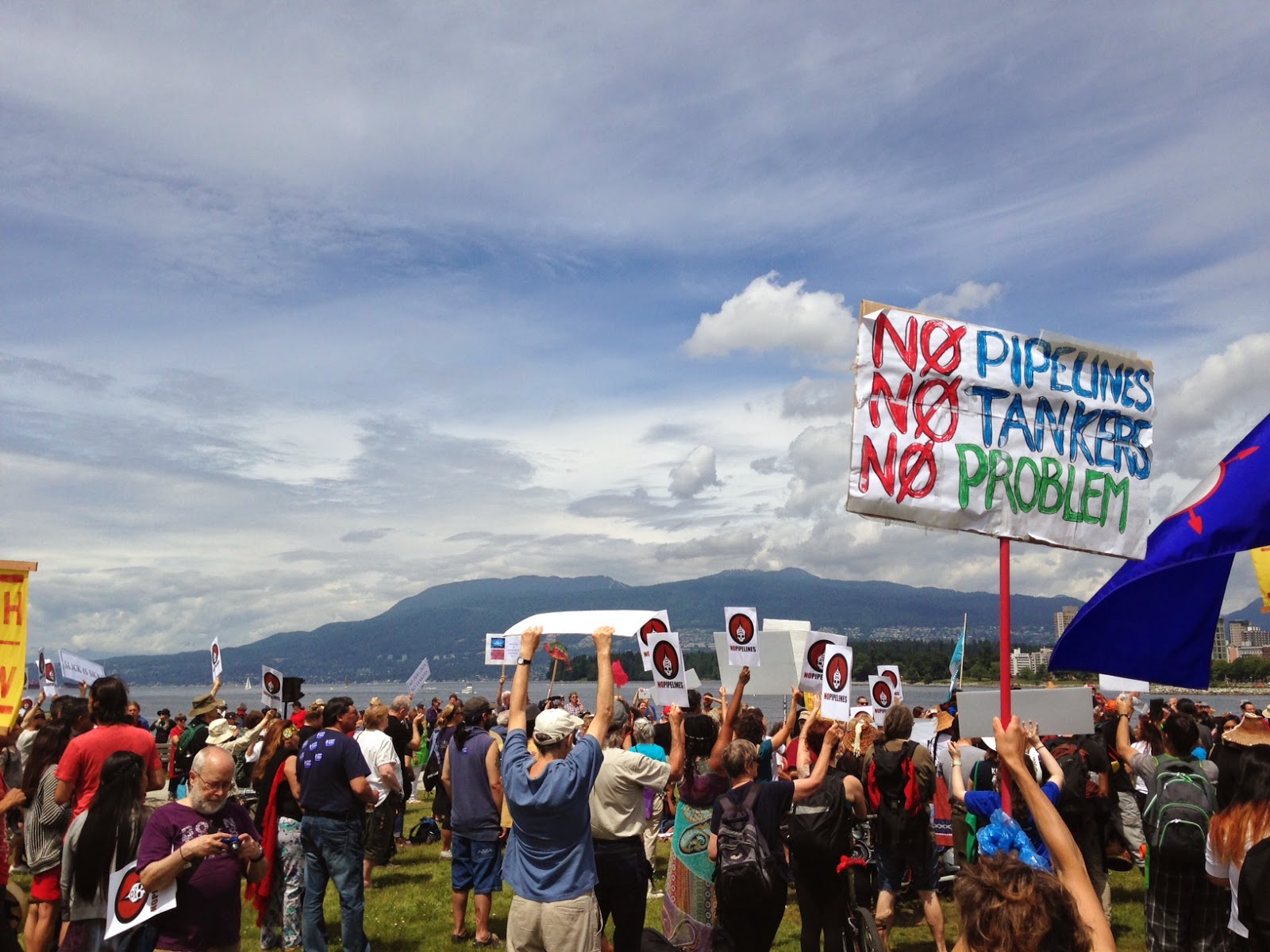
Protect Our Sacred Waters rally, Vancouver, June 2014
Photo: Alexandra Woodsworth
And for good reason. Kinder Morgan’s expansion poses the same threats as Enbridge – an oil spill that could devastate our environment, economy and coastal communities, and a yearly climate impact greater than the combined annual emissions of 90 nations – and the same negligible benefits for BC. Opponents of these projects aren’t NIMBYs. British Columbians don’t want risky tar sands pipelines or tankers anywhere in our province – we want to go in a different direction.  Our investments should help us transition away from fossil fuels, not tie us to more resource extraction and increase our contribution to climate change.

In the days leading up to the Enbridge decision, Premier Clark came under immense pressure to say ‘no’ to Enbridge, and it worked: the province said Enbridge had not met their five conditions, and they would deny permits if necessary. Those same five conditions apply to Kinder Morgan, and we need to bring the same pressure to bear to ensure the province takes a strong stand on the southern tar sands pipeline.

Compared to the JRP’s Enbridge hearings, the NEB’s Kinder Morgan review has dramatically restricted public participation and speeded up the timeline. And this week we learned just how brazenly the federal cabinet ignored public concern expressed during the JRP. Together, this means we need to work even harder to generate public pressure outside the formal review process.

We need to talk to more people in our communities, make more noise on the streets, raise more money for First Nations legal challenges, and – whatever it means for each of us – step up to the next level of what we’re willing to do to protect our coast and fight for a better future. Here’s a list as some food for thought, and stay tuned for updates on our Save the Salish Sea page.

May 8, 2014

Cross border conference sees hope & the challenges ahead


When I think about the Salish Sea Ecosystem Conference, which took place last week in Seattle, I find it ironic that a cross-border conference could make me feel so many opposing feelings. I left feeling hopeful and deeply concerned, energized and exhausted, frustrated and thrilled, ready to act and wondering how. We live in a spectacular region, and so many people love it and are ready to work to make that happen – but we need to really get our heads together to figure how we do that – and now.  You know, those kinds of feelings!

Every two years, hundreds of scientists, policy makers and members of civil society gather together to share, discuss and plan for how we will protect our shared waters of the Salish Sea. I’ve had the privilege of attending 6 of these conferences over the years and I was thrilled this year to be joined by 3 other GSA staff – Michelle Young (Clean Marine BC), Alexandra Woodsworth (Energy and Shipping) and Sebastian Merz (Waterfront Initiative). Together we gave 3 talks and spoke to dozens (possibly hundreds!) of people about our work, our vision and our concerns.

Here are just a few of our shared thoughts, impressions and memories about the conference we’d like to share with you:
  • The Pacific North West is the ‘thin green line’, the last frontier and ground zero for one of the most monumental environmental battles ever seen, and at a pivotal moment for all life on the planet. There is a huge volume and variety of energy proposals pushing to get out to the Asian market, and this is the worst place in the world for them to want to do this. 
  • Simply put – we need to start thinking about this as one region, no border, when it comes to fossil fuel transport. We’re still not there yet and this highlights a real gap in communication and our organizing efforts, if we want to protect the entire Salish Sea. 
  • We need to address development proposals in a much more integrated fashion. We heard how so many proposals sound exactly the same — insert # of jobs, mitigating measures here, etc, etc. Adjustments and tweaks are really not enough given cumulative effects of all development; we need a fundamental paradigm shift.
  • A recurring theme – Canada lags behind the US: 
    • Canada is lagging behind the US on dealing with derelict vessels, recreational vessel sewage discharge, and funding for pump-out facilities.  When will we step up?
    • Washington's efforts around engaging citizens in oil spill response as compared to BC's (comparatively nothing) was incredible — they have a whole website run by Department of Ecology for training. Not so in BC.
    • There are a large number of NGOs involved in protecting Puget Sound and in doing research. We have great NGOs in BC, but our impression was that the Sound gets a lot more attention than the Strait does up here.  That has to change.
    • Where were the Canadian federal scientists?  We were so impressed by the number of interesting presentations from NOAA researchers and staff. The quality of the research and the freedom with which they were allowed to speak was a sharp contrast to Canadian federal scientists, many who were not able to attend due to travel budget limitations (or other reasons). Our impression is that science and communication is supported in Washington, a stark contrast to what is going on in Canada with the gutting of DFO and other agencies.  
  • At a science conference, social sciences are equal partners.  The social science panels were very interesting and very popular. Integrating social science approaches into an ecosystem conference seems to have struck a chord – and is necessary to creating a sustainable region.
  • Asking communities what they want.  We saw several presentations on redevelopments and conservation which keyed in on the challenge and opportunity of engaging the community in a real way – you know, as if we really wanted to know what they thought!  Phillip Levin is doing great work on how to build community support for conservation, including asking people how much development they want and how much they are willing to pay to restore ecosystems. Mike Stoner from the Port of Bellingham talked about the re-development of the waterfront and how the community wants jobs, housing and nature on the waterfront. We set the bar high when we ask people what they want – and shouldn’t we always?
  • We have to start being able to account for our natural capital at a local level. Right now municipalities have no proper way of doing this other than, for example, accounting for your freshwater resources by accounting for your water pipes and other infrastructure. Being able to account for natural capital directly could help make conservation easier and more attractive.
  • We were inspired by the overall feeling of hope and all the amazing work that people are doing, all of the brilliant minds coming together. One talk was on public eco-art and science based collaboration — using art, infrastructure and science to turn public works into beautiful, clean, functional and thought provoking spaces. Going beyond mitigating measures to a whole new level, using science based solutions to turn a negative into a positive (rather than less of a negative). That’s the kind of revolutionary ideas we need!
And that’s just some of what we heard.
 
In addition to the conference itself, we were greatly pleased by the media pick-up — including stories about at risk species and fossil fuel transport.  It’s so important for the communities of the Salish Sea to see what their scientists and policy leaders are doing in the region and we hope this is the start of a more robust conversation.

So, here is our word cloud for the Salish Sea Ecosystem Conference: Hope – hard work – brilliant minds – thin green line – pivotal moment in history – need for change – Canada lagging behind US in laws, in leadership, in investment – more cross border thinking – government science/research in US compared to Canada, investment in science – social and natural science – asking communities what they want – accounting for natural capital – safety on paper vs safety on water.

We love where we live. We need to protect where we live. Knowing that so many feel the same way is so hopeful. I guess I’m not conflicted after all.


April 3, 2014

Who will have a voice in the Kinder Morgan hearings?

Yesterday the National Energy Board (NEB) denied nearly half of those who applied to take part in the upcoming review of Kinder Morgan’s Trans Mountain pipeline expansion their preferred method of participation.

Of the 2,118 applications received, 452 were ‘downgraded’ by the NEB from intervenor to commenter status, and 468 were denied participation altogether. In addition, 400 were granted intervenor status and 798 who requested commenter status were granted it.  You can find out if you were accepted as an intervenor or commenter, or if your application was denied.

With this decision from the NEB, hundreds of individuals and groups have now been shut out of the hearings, and denied the chance to officially voice their important concerns about Kinder Morgan's tar sands pipeline (and the 400+ tankers it would bring through the Georgia Strait each year).
It’s a sad day for democracy in Canada, when nearly a thousand people who stepped up to take part in a complex regulatory process to have their say about a project of national significance are shut out of the hearings.

Georgia Strait Alliance has been granted permission by the NEB to fully participate in the hearings as an intervenor, and we will do our best to use this as an opportunity to represent the voices of those who have been excluded.

For those who have been accepted as commenters or intervenors, yesterday’s announcement also came with some important information about timelines and advice on how to participate. Here are a few highlights:

·         NEB workshops for commenters & intervenors begin next week and run throughout the process
·         Submitting requests for information to Kinder Morgan begins May 2014
·         Commenters can file one letter, and must do so by September 9, 2014
·         Intervenors can provide written evidence, ask questions, present written and oral argument
·         Oral hearings by intervenors will take place in February 2015 (location and exact date not yet announced)
·         NEB must complete its review by July 2, 2015

UPDATE (April 21, 2014): The City of Burnaby has prepared a very comprehensive information package to help intervenors navigate the process, and will also be holding their own workshops.

We'll keep posting more information about the hearing process – and equally important actions you can take outside the process – in the weeks to come, so stay tuned for updates!

February 11, 2014

LNG: coming soon to the Georgia Strait?

With the rush to develop BC’s liquefied natural gas (LNG) industry, new projects seem to get announced every week. They have been mainly confined to the north coast – until now.


Photo: www.globalsecurity.org
Alongside the Discovery LNG project in early stages of development in Campbell River, and rumours of a potential export facility in Port Alberni, the Woodfibre LNG project proposed for Howe Sound has now progressed to the stage of consultation and environmental assessment.

Woodfibre proposes to build an LNG processing and export facility seven kilometres southwest of Squamish. If approved, the project would bring 40 LNG tankers through Howe Sound each year, carrying BC gas to global markets.  An associated proposal, by FortisBC Energy, would see a 52-kilometre pipeline built from Coquitlam, across the Squamish Estuary, to bring gas to the Woodfibre plant.

You can find out more about the project at a series of consultation sessions being run by Woodfibre in the Squamish area in February; you can also submit comments online any time up to February 28th.
We’ve been hearing a number of concerns from community members about the project, including:
  • The risks of an collision, spill or other accident in the handling and transport of a hazardous material like natural gas, particularly in the narrow confines of a fjord like Howe Sound
  • The day-to-day noise disturbance and other impacts of increased tanker traffic on endangered orca, humpback whales, grey whales and other marine species, many of which are only recently returning to Howe Sound following decades of environmental abuse;
  • Foreshore and recreational impacts in a significant tourist destination from the wake of the large LNG carriers that are proposed
  • The cumulative impacts of the Woodfibre facility in combination with other industrial projects proposed for the region
Residents have also been outraged about the way that government consultation has been carried out so far. The first major opportunity for public input took place over the Christmas holidays, from December 17 to January 6, while many were away from their computers and enjoying time with family – almost as if it was intended to slip past without anyone noticing. You can read comments submitted by those who were able to make the deadline here, which provides a good sample of community concerns.

Concerns about the Woodfibre proposal are part of a much wider conversation that needs to happen about the current push to hang BC’s economic future on LNG. How can we develop LNG at the pace envisioned and still meet our targets for combating climate change? If supplying gas to new LNG facilities leads to an increase in fracking – with its associated water contamination, air quality and health impacts – is that something British Columbians can live with? What about pollution of the air and marine environment around the terminals themselves?

This conversation has been going on for much longer in northern BC, where a dozen LNG proposals are on the table and residents are coming together to express their concerns. The time has come for communities on the south coast to educate ourselves, get organized, and start talking about whether we want new LNG developments in the Georgia Strait.

If you have thoughts on this, I’d love to hear them! Get in touch at alexandra@georgiastrait.org


January 16, 2014

The clock is ticking - apply to take part in the Kinder Morgan hearings today

This past Wednesday, the National Energy Board (NEB) quietly announced that it is taking applications for public participation in its review of Kinder Morgan’s proposal to expand the Trans Mountain Pipeline.

The window for individuals, business and groups to apply is quite short, with applications being accepted between January 15 and noon (PST) February 12.  If you don’t apply during this window, you won’t be able to officially comment on the project when the hearings roll around a few months later.

The bottom line? If you want to tell the government what you think about Kinder Morgan’s pipeline plan, you need to fill in this form.  This may feel daunting but we and our colleagues are here to help you have a voice in this process.  Here’s how:

Step 1. Visit the NEB website 
Read more about the process, to learn about webinars the NEB is providing and to fill out the online application form.  

Step 2. Learn more about what’s involved in participating in a NEB hearing process
When you fill out the application form, you can ask to be a ‘Commenter’ (submit a letter of comment) or ‘Intervenor’ (requires greater time commitment, allows you to take part in oral hearings, and allows you to ask for information of Kinder Morgan – and them of you). This website provides step-by-step advice alongside each page of the NEB online form.

Step 3. Get advice
We know the process looks daunting, and we want to make sure that everyone who cares about this issue gets the support they need to have their say. We and other organizations will be working together to hold workshops and webinars, and post information on our websites, to offer advice and help you fill out the form. Here are a few confirmed workshops and community meetings you can attend to get help:

Feb 3 - 7pm, Maple Ridge (hosted by Pipe Up Network and ForestEthics Advocacy)
Feb 4 - 7pm, Chilliwack (hosted by Pipe Up Network and ForestEthics Advocacy)
Feb 5 - 7pm, Abbotsford (hosted by Pipe Up Network and ForestEthics Advocacy) 
Feb 5 - 7pm, North Vancouver (hosted by ForestEthics Advocacy)
Feb 5 -12pm,  webinar (hosted by West Coast Environmental Law, Forest Ethics and Sierra Club BC) 
Feb 6 - 2pm - 8pm, Langley (hosted by Pipe Up Network and ForestEthics Advocacy) 
Feb 8 - 7pm, (note date change) Pender Island (hosted by Raincost, Gulf Island Alliance and GSA)
Feb 10 - 7pm, Downtown Vancouver (hosted by ForestEthics Advocacy)
Feb 11 - 6pm, Victoria (hosted by the Wilderness Committee)

The NEB process seems designed to ensure as few as possible people take part – restricting public participation, creating a primarily online process (getting hard copy forms is possible but must be requested through the NEB and takes time) and not taking climate change into account being high on the list– but it is your one opportunity to formally state your opinion, so make sure you don’t miss out.

Important:

·        To be able to participate, the NEB wants you to show that you are either ‘directly affected’ (eg. live or own property along the pipeline or tanker route, or have a job that could be affected by a spill etc.) or have ‘relevant information or expertise’ (ie. knowledge of a local place, or information about a relevant business sector such as tourism or recreation).  If you feel that you will be impacted in any way by Kinder Morgan’s project, it’s worth submitting an application and going on record that you want your voice to be heard.  Here is a guide to help.

·        Don’t let the first page dissuade you – setting up your account to apply is straight forward.   The NEB has added a first level of access that seems designed to frustrate possible participants – don’t give up!  Select “GCKey Login” and apply for your access key.  It won’t take long and soon you’ll be through to the actual form.  

Find out more:
    •        Using your voice: participating in the NEB’s review of Kinder Morgan’s pipeline and tanker proposal (2-page briefing prepared by Raincoast, Sierra Club and Pipe Up Network)
    •         Let BC Decide (website from Burnaby MP Kennedy Stewart)
    •         NEB PowerPoint presentation
    And don’t forget to spread the word!

    Share your concerns about Kinder Morgan’s proposal with your friends, family, neighbours and colleagues, and encourage them to get involved – whether it’s by registering to take part in the NEB hearings, contacting your MP or MLA, or getting active with one of the many community groups springing up to oppose this project.

    Please visit our website, and follow us on Twitter or Facebook to find out the latest.