Georgia Strait Alliance is the only citizens' group focused on protecting the marine environment in and around the whole Strait of Georgia – Canada's most at-risk natural environment, and the place where 70% of British Columbians live, work and play. We are committed to a future for our region that includes clean water and air, healthy wild salmon runs, rich marine life and natural areas, and sustainable communities.

July 21, 2014

Kinder Morgan hearings delay: a win for pipeline opponents

This week the National Energy Board (NEB) announced that it was ‘stopping the clock’ on its review of Kinder Morgan’s proposed pipeline expansion, which will delay the NEB’s final recommendation – and the ultimate federal Cabinet decision – until 2016.

Tanker under Second Narrows Bridge
Photo: Sarama (www.livingsalishsea.ca)
The delay is due to the fact that Kinder Morgan changed a portion of its ‘preferred route’ for the new pipeline after it filed its application to the NEB last December. The NEB is providing the extra time so that Kinder Morgan can carry out additional studies on the new route, which involves tunneling through Burnaby Mountain. When the route change came to light in May, many community members called for the NEB review to be paused or restarted, particularly those in Burnaby who could be most directly affected by the route switch.

There’s no doubt that major flaws remain in the NEB review process: there still won’t be any in-person cross-examination of the evidence presented, Kinder Morgan is still failing to adequately answer the questions intervenors have been asking, and the project’s climate impacts are still barred from discussion.

However, the delay is most definitely a win for all of us who have been criticizing both the project and the process.

The longer the review takes, the more likely it is that one of the many obstacles to the project’s completion will be successful, including changing market forces, a raft of lawsuits from First Nations and others, and citizens from across BC mobilizing to oppose the project. Perhaps most notably, the final decision to approve or deny the project will be made by whoever wins the next federal election in 2015, giving citizens a chance to hear where all the parties stand on Kinder Morgan, and the opportunity to vote accordingly.  

If you’re an intervenor or a commenter in the NEB review, here are the key new deadlines you should be aware of:

·         Deadline for commenters to file letter of comment: March 16, 2015 (commenter workshops will now take place in February 2015)
·         Deadline for intervenors to file written evidence: March 16, 2015
·         Deadline for intervenors to file written argument: July 29, 2015
·         Oral hearings: July 2015
·         NEB releases its final report and recommendations: 25 January, 2016

You can find out more from the NEB’s table of revised hearing events, and as always, if you have any questions or comments, please get in touch at alexandra@georgiastrait.org.win

July 14, 2014

Mixing concrete and asparagus on Granville Island

Why a polarized and non-transparent debate will hurt the future of Vancouver’s treasured waterfront hub

Years ago, someone came up with the idea of putting vegetables on concrete mixers to drive them around Vancouver, and guess what, it is working. Granted, the trucks aren’t used to bring veggies to market—quite the opposite: the larger-than-life ads depicting carrots and asparagus on cement trucks bring Granville Island’s public market to people’s attention and have become a familiar and endearing sight around the city. The trucks belong to the Ocean Concrete/Lehigh Hanson plant that is located right next to the market and keeps the island’s industrial heritage alive.

Ocean Concrete's cement plant is one of the last remaining 
industrial facilities on Granville Island
Photo: Joe Mabel (licensed under GNU Free Documentation License)
The marketing folks behind the ads knew how to make people pause and think. Their campaign encapsulates what makes Granville Island so special: it’s a place, in the middle of the city, where unusual things come together—like the public market, a cement plant, an arts school campus, theatres, galleries and other creative spaces, a next-door fishing harbour, and much more. The symbiosis of all these facilities is what has made Granville Island so popular with locals and international travelers alike.

Now the island is bracing for change. Emily Carr University is moving away to its new campus in East Vancouver, and the conversation about the future of the area has started to take off. In February, the Vancouver Sun’s Daphne Bramham suggested that Granville Island was in need of re-imagination and renewal to inject new life, creative energy and local flavour.

Recently, the conversation has taken a much more antagonistic turn. News leaked that Port Metro Vancouver was negotiating to take over Granville Island from the Canadian Mortgage and Housing Corporation. This was not well received by everyone, including the City of Vancouver, who according to a statement by Mayor Gregor Robertson would like to see a “transfer or lease to the City, or the creation of an independent local authority” to run the island.

There are two things that concern me about the place we’ve suddenly found ourselves in as we are talking about the future of Granville Island:

First, it didn’t take long for the debate to be framed around camps, positions, antagonists, and strong conclusions about what’s right or wrong. Arguments about whether the Port has a “proven track record of running things” or represents a bureaucracy that Granville Island must be saved from provide easily combustible fuel for a heated discussion, but they are unlikely to produce good outcomes for the larger community.

Granville Island is a core part of the waterfront in Vancouver, a maritime city that owes much of its allure and prosperity to its connection to the ocean and the world. Consequently, the Port and the shipping industry should be part of this conversation. But so should citizens and other stakeholders—which leads me to my second concern.

The secrecy surrounding the negotiations and the lack of transparency and engagement in the process so far do not bode well for the discussion moving forward. Granville Island arguably plays an important role for Vancouver: as a public space, a tourist destination, and a source of diverse economic and job opportunities in the city centre. So all those who make Granville Island what it is and who want to contribute to and benefit form it in the future need to be involved: tenants, the City, industry, civil society, and citizens.

Photo: Ruocaled/Flickr (licensed under CC BY 2.0)
If the polarization and lack of transparency and engagement continues, we risk squandering great opportunities for our city. Granville Island really is unique as an amalgamation of creativity, public spaces, industry, and other economic activities (such as retail, services, hospitality). And I believe that if Vancouver is to achieve the goal of becoming the world’s greenest city, moving industries elsewhere won’t cut it. Real leadership and innovation would mean making our industrial activities on the waterfront more sustainable and harmonizing them with the ecosystems and the communities that surround them—without having to move more people to jobs in the suburbs and trucking more goods back into the city.

Divisive debates are not going to get us there. The way to innovative solutions that benefit us all is through engagement, open dialogue, and collaboration, which is the approach Georgia Strait Alliance is taking with our Waterfront Initiative. We are the backbone organization for a growing network of partners and stakeholders that works to restore, protect, and revitalize Vancouver’s shoreline. Our goal is to ensure that the waterfront can continue to be a place where we live, work, play, travel, connect with and protect nature—in other words, all that Granville Island represents so unmistakably in the heart of the city.

July 4, 2014

Ryan joins GSA for the summer

Hello GSA supporters,

Ryan with his friend and classmate Rabbi Salih
during his recent convocation ceremony. 
My name is Ryan Butler, and I am excited to be joining GSA’s dynamic staff this summer as the Clean Marine Outreach and Engagement Coordinator. Prior to this position, I’ve worked and volunteered with several NGOs and student organizations, such as: Camp Hornby, The World University Service of Canada, and The Radio Malaspina Society.

Having recently graduated from Vancouver Island University with a degree in sociology and political studies, I am thrilled to have found a summer job that is relevant to my field. Come September, I intend to carry my summer experience forward into my Master’s program at the University of Victoria.

I believe that all Canadians ought to undertake practices that protect or restore our environment whenever possible. As such, I am excited about joining GSA where I can fulfil this belief while still working. Here, students are able to making significant contributions to our public discussions regarding both regional and global issues.

Identifying environmental hazards is, of course, necessary but insufficient for creating change. Instead, change requires social and political processes to create and implement a variety of solutions. GSA’s Clean Marine BC program is one such solution, and therefore, I’m excited to contribute to its expansion this summer. Having previously researched the establishment of B.C.’s Forestry Stewardship Council, I appreciate how such eco-certification programs provide businesses and consumers with an avenue for reducing their environmental impact.

I am excited about the Clean Marine BC program, but I also recognize that GSA’s current Spills and Tankers Campaign, against the expansion of Kinder Morgan’s Trans-Mountain pipeline and increased fossil fuel exports, is confronting the region’s greatest environmental threat. Many of the benefits of CMBC would be greatly diminished should the Strait experience a major tanker spill, but together these GSA programs show that achieving environmental sustainability will require both preventative and adaptive actions.

I am proud to be contributing to GSA’s encompassing environmental work to protect the Strait, its adjoining waters, and its communities. 

June 25, 2014

Summer Outreach Begins!


Hello Fabulous Readers!

Taking a break from field work with the Larabanga
Girls Dance Group in Larabanga, Ghana
My name is Natalie and I am one of the lucky students who was hired to work with the Georgia Strait Alliance throughout the summer.

I’m a life-time resident of Nanaimo, and I just finished the third year of my degree in Tourism Management at Vancouver Island University. In my free time I love trail running, gardening, and exploring as much as possible with Skeena, my one year old Shiba Inu.

I wanted to work with GSA because I love the Georgia Strait!  I also believe in the power of community conservation management. Last summer, I traveled to Ghana and visited the Wechiau Community Hippo Sanctuary, which is made up of several communities that work hard to protect the resident hippo population. The conservation model was very complex, but through tourism, the community was able to benefit in many ways. Some residents had to change their behaviors, but they were still able to go about their daily lives. Even though the Georgia Strait covers a much greater area and population base, I believe that the Strait Community can come together and experience many positive benefits if everyone participates in making it happen.

The thing I’m looking forward to the most this summer is traveling around and talking with the public. I love meeting people, chatting, and making sure that everyone is enjoying themselves.  The Georgia Strait Alliance has some very powerful campaigns on the go, and people are very interested. This past weekend, Ryan and I had some great conversations surrounding the Drift Card Study and the Kinder Morgan Expansion. People were in awe with the spill maps and seeing how far and fast oil from a spill could spread. Community outreach is a great way to spread awareness with people, and also hear what individuals have to say.  Make sure if you see us out on the road somewhere that you stop by to say ‘hello’!

The program I’m most excited to help out with is GSA’s newest program- The Waterfront Initiative! I’m so thrilled with this idea because it brings everyone together in a brand new way and for a powerful purpose. Regardless of how individuals use the waterfront in Vancouver – work, home, industry, or play – the Waterfront Initiative has the power to create a collective image of what the waterfront should look like and work to make that happen. After all, isn’t the waterfront one of Vancouver’s most beautiful assets? I hope to help out with the launch of this project as much as I can while I’m here, throughout the summer and beyond.

June 20, 2014

New chapter, new resolve against unwanted pipelines

The approval of the Enbridge Northern Gateway pipeline makes it clearer than ever that BC is going to have to have to stand up for itself in the face of a federal government willing to impose unwanted projects despite overwhelming opposition – and the response of First Nations and British Columbians to the news this week has shown an unwavering resolve and an inspirational source of hope that we can win this fight.

Although Northern Gateway has now cleared another major regulatory hurdle, a combination of First Nations legal challenges, a citizen push-back that could range from a province-wide vote to civil disobedience, and (at least currently) a strong ‘no’ from the Provincial government mean that the pipeline is unlikely to ever be built.

When Enbridge first floated the proposal in 2005, no one could have imagined how controversial it would become: at the time such projects were usually nodded through without a great deal of interest. Now it’s shaping up to be a defining issue for many BC communities and  a top voting issue in the 2015 federal election.

The campaign to stop Northern Gateway has also built a broad and strong coalition, and sparked a powerful citizen’s movement. We are grateful to everyone who has worked so tirelessly for so long, especially First Nations and non-indigenous communities on the front-lines in northern BC, and we want you to know that we stand with you, and are inspired by your leadership and resolve.

We are also grateful for the path that has been forged –  the lessons learned and the alliances built –  that those of us working on the south coast are now following in our efforts to stop Kinder Morgan’s pipeline proposal. This project too was once seen as a “slam-dunk”, and now struggles against “overwhelming opposition” (to quote the Financial Post, no less). Polls are showing rising levels of concern, at least two legal challenges are already underway, and the NEB’s review process has more people involved as intervenors and commenters than any project in its history. In other words, the Kinder Morgan pipeline is shaping up to be a battle royale too.

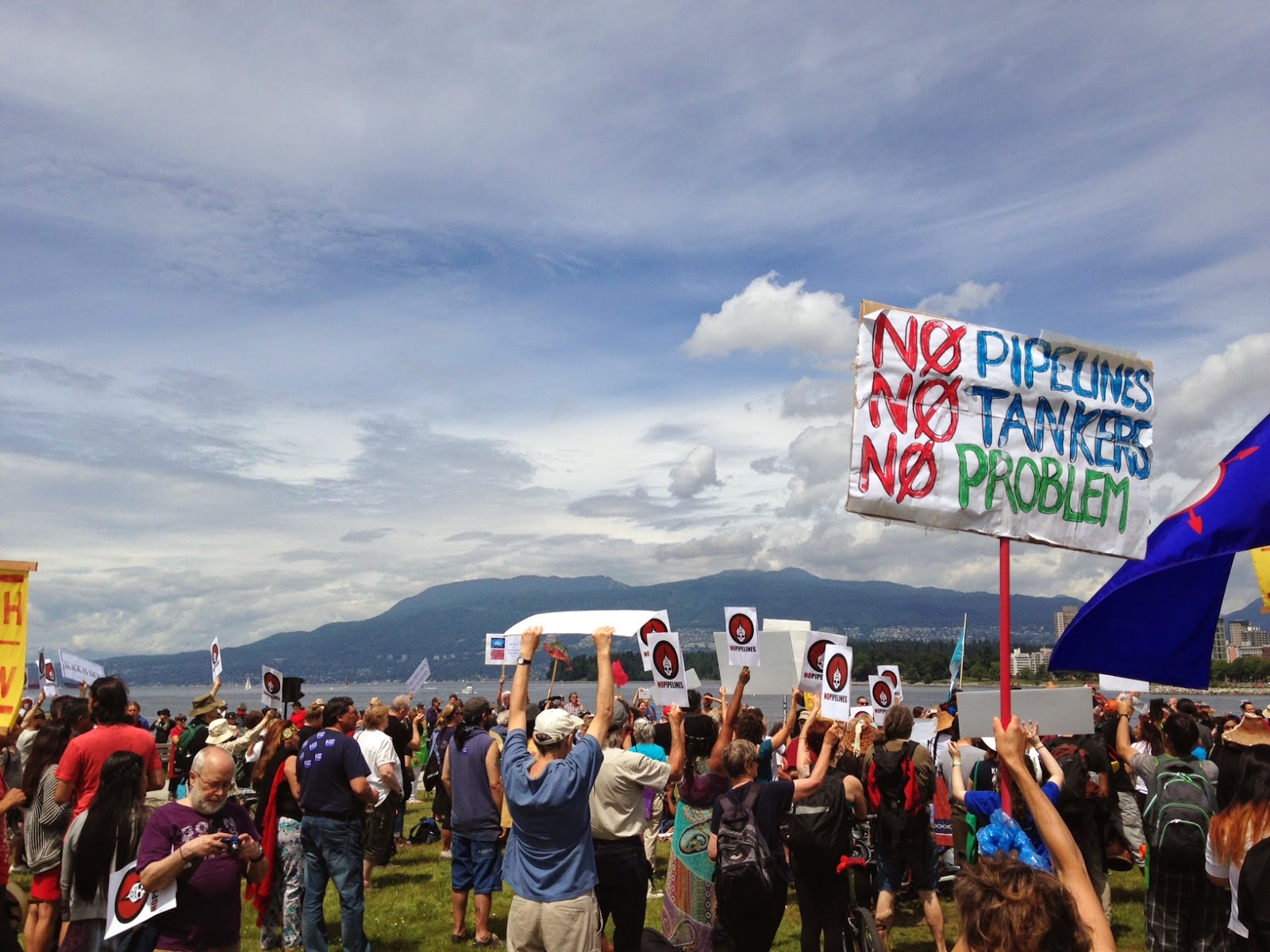
Protect Our Sacred Waters rally, Vancouver, June 2014
Photo: Alexandra Woodsworth
And for good reason. Kinder Morgan’s expansion poses the same threats as Enbridge – an oil spill that could devastate our environment, economy and coastal communities, and a yearly climate impact greater than the combined annual emissions of 90 nations – and the same negligible benefits for BC. Opponents of these projects aren’t NIMBYs. British Columbians don’t want risky tar sands pipelines or tankers anywhere in our province – we want to go in a different direction.  Our investments should help us transition away from fossil fuels, not tie us to more resource extraction and increase our contribution to climate change.

In the days leading up to the Enbridge decision, Premier Clark came under immense pressure to say ‘no’ to Enbridge, and it worked: the province said Enbridge had not met their five conditions, and they would deny permits if necessary. Those same five conditions apply to Kinder Morgan, and we need to bring the same pressure to bear to ensure the province takes a strong stand on the southern tar sands pipeline.

Compared to the JRP’s Enbridge hearings, the NEB’s Kinder Morgan review has dramatically restricted public participation and speeded up the timeline. And this week we learned just how brazenly the federal cabinet ignored public concern expressed during the JRP. Together, this means we need to work even harder to generate public pressure outside the formal review process.

We need to talk to more people in our communities, make more noise on the streets, raise more money for First Nations legal challenges, and – whatever it means for each of us – step up to the next level of what we’re willing to do to protect our coast and fight for a better future. Here’s a list as some food for thought, and stay tuned for updates on our Save the Salish Sea page.